
812 Campus Placements - 2026 :
720 Campus Placements - 2025 :
AI readiness as a mechanism linking educational inputs to career-related outcomes. AI readiness can be understood as the extent to which individuals are prepared to engage with AI technologies in applied contexts, reflecting not only personal competence but also the extent to which learning environments enable such engagement. Exposure to laboratory activities, group work, and experiential learning opportunities plays a central role in shaping what students ultimately gain from AI-related education.
Students who possess higher levels of AI literacy are more likely to perceive AI technologies as accessible, relevant, and useable in practice.
Table 1 presents a comparison of the key competencies required for AI-ready students from the perspectives of academics and Employers. Both groups recognize the importance of combining AI-related skills with essential human capabilities, but they prioritize these competencies differently. According to academics the highest priority is the effective use of AI tools, reflecting the growing need for students to understand and leverage AI technologies in academic and professional environments. Their second priority is the integration of human judgment with AI capabilities, emphasizing the ability to make informed decisions while collaborating with intelligent systems. Adaptability is ranked as the third priority, highlighting the need for continuous learning and flexibility in a rapidly evolving technological landscape.
Table1. Key competencies for AI-ready graduates: employer VS educator views
| Market | Perspective | Priority 1 | Priority 2 | Priority 3 |
|---|---|---|---|---|
| Overall | Academics | AI tool use | Human judgment + AI capabilities | Adaptability |
| Employers | Communication and collaboration skills | Adaptability | Human judgment + AI capabilities |
Employers, on the other hand, place the greatest emphasis on communication and collaboration skills, indicating that the ability to work effectively with teams and stakeholders remains critical in the workplace. Adaptability is identified as the second most important competency, reflecting the demand for professionals who can quickly adjust to new technologies and changing business requirements. The combination of human judgment and AI capabilities is ranked third, underscoring the importance of balancing technological proficiency with critical thinking and decision-making skills.
The Figure 2 represents a consolidated vision that runs from student to industry ready graduate by building a more effective path from the classroom to the workplace.
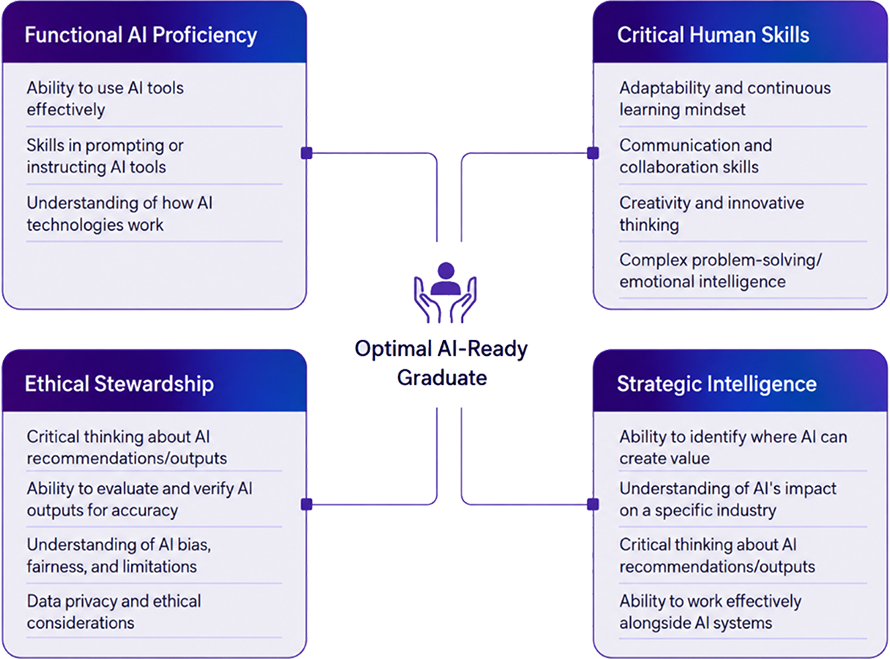
Figure 2. The optimal AI-ready graduate
For a contemporary graduate, readiness is a multifaceted construct that combines the following:
From day one, students must arrive functionally fluent in workplace specific tools by developing dossier of completed projects. They are able to take standard AI tools and apply them to a professional workflow. This set of skills represents the type of human-in-the-lead aptitude that employers demand. While across markets, learners prioritize the “ability to use AI tools effectively” as the top-rated requirements.
Ability to use AI tools effectively; Skills in prompting or instructing; Understanding of how AI technologies work.
The AI-ready graduate will have successfully cultivated the ability to identify exactly where AI adds value and where it creates risk, a skill that 1 in 3 employers today report is of high importance when hiring into their organizations. They will have an appreciation for how AI can be deployed as something more than a productivity or efficiency shortcut.
Ability to identify where AI can create value; Understanding of AI’s impact on a specific industry; Critical thinking about AI recommendations/outputs; Ability to work effectively alongside AI systems.
In an era of ubiquitous AI, the AI-ready student must be equipped to mitigate risk. They will understand bias, fairness, data privacy, and data integrity. They will be confident in navigating, and complying with, institutional and professional policies.
This set of skills involves a student’s capability to serve as an ethical filter and a risk mitigation manager for employers, focusing on safety, integrity, and the ethical deployment of technology.
Critical thinking about AI recommendations/ outputs; Ability to evaluate and verify AI outputs for accuracy; Understanding of AI bias, fairness, and limitations; Data privacy and ethical considerations.
The optimal graduate will possess a skillset that is valued for the things that AI cannot replicate. Aware that current models have a finite shelf-life, they will bring an adaptable, agile mindset and value opportunities to learn and ensure they remain relevant as the pace of change accelerates.
It is required; critical human skills are equally important to functional AI proficiency and half of all employers’ rank communication and collaboration. This set of skills represents a graduate’s competency to provide what no AI model can: human judgement, creative thinking, collaborative and emotional intelligence. Whereas AI automates execution, the AI-ready graduate possesses the relational and cognitive capabilities to bring purpose and direction.
Adaptability and continuous learning mindset; Communication and collaboration skills; Creativity and innovative thinking; Complex problem-solving / Emotional intelligence.
Over the past two years, AI has advanced in leaps and bounds, and enterprise-level adoption has accelerated due to lower costs and greater access to capabilities. Many notable AI innovations have emerged (Exhibit 1). For example, we have seen a rapid expansion of context windows, or the short-term memory of LLMs. The larger a context window, the more information an LLM can process at once. To illustrate, Google’s Gemini 1.5 could process one million tokens in February 2024, while its Gemini 1.5 Pro could process two million tokens by June of that same year. Overall, we see five big innovations for business that are driving the next wave of impact: enhanced intelligence and reasoning capabilities, agentic AI, multimodality, improved hardware innovation and computational power, and increased transparency.
Exhibit 1: Illustrative capabilities of gen AI platforms from select frontier labs, non-exhaustive
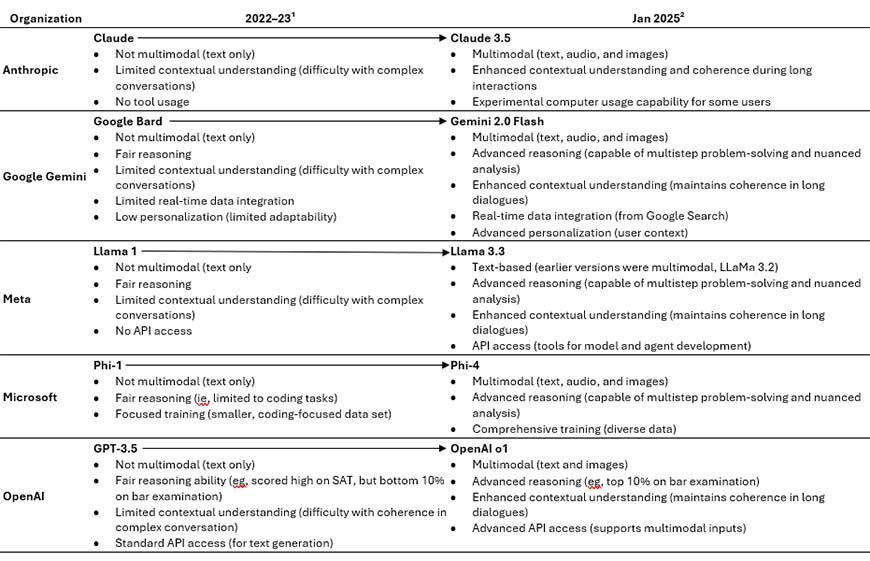
The ability to reason is growing more and more, allowing models to autonomously take actions and complete complex tasks across workflows. This is a profound step forward. As an example, in 2023, an AI bot could support call center representatives by synthesizing and summarizing large volumes of data including voice messages, text, and technical specifications to suggest responses to customer queries. In 2026, an AI agent can converse with a customer and plan the actions it will take afterward for example, processing a payment, checking for fraud, and completing a shipping action.
Today’s AI models are evolving toward more advanced and diverse data processing capabilities across text, audio, and video. Over the last two years, we have seen improvements in the quality of each modality. For example, Google’s Gemini Live has improved audio quality and latency and can now deliver a human-like conversation with emotional nuance and expressiveness. Also, demonstrations of Sora by OpenAI show its ability to translate text to video.
Hardware innovation and the resulting increase in compute power continue to enhance AI performance. Specialized chips allow faster, larger, and more versatile models. Enterprises can now adopt AI solutions that require high processing power, enabling real-time applications and opportunities for scalability. For example, an e-commerce company could significantly improve customer service by implementing AI-driven chatbots that leverage advanced graphics processing units (GPUs) and tensor processing units (TPUs). Using distributed cloud computing, the company could ensure optimal performance during peak traffic periods. Integrating edge hardware, the company could deploy models that analyze photos of damaged products to more accurately process insurance claims.






 Work with Us
 Campus Map
 How to Reach Us
 Online Degree Verification
 IARE Mail
 Photo Gallery
 Virtual Tour