
799 Campus Placements - 2026 :
720 Campus Placements - 2025 :
The Emerging & Immersive Technologies competency-building programs offered by the Competency Building and Consultancy (CBC) Centre equip students with industry-relevant knowledge and practical skills in Technologies Augmented Reality/Virtual Reality (AR/VR) and Internet of Things (IoT) & 5G. Through hands-on laboratories, real-world projects, and industry-aligned learning, students develop competencies in embedded systems, wireless communication, cloud and edge computing, immersive application development, Unity3D, IoT architectures, smart devices, and interactive digital experiences. The programs emphasize experiential learning and project-based development, enabling students to design, develop, integrate, and deploy innovative smart and immersive technology solutions. These competency-building programs enhance employability and prepare students for successful careers in IoT, 5G communications, AR/VR development, Industry 4.0, smart systems, and next-generation digital technologies.
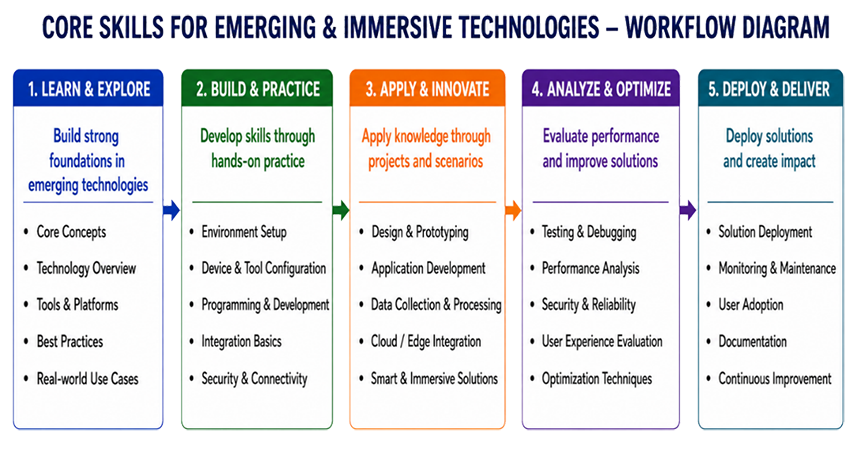
Structured competency-building journey in Emerging & Immersive Technologies, highlighting the progressive learning process.
The focus of AR/VR Solutions is to provide students with practical knowledge of immersive technologies and interactive application development. The program develops hands-on skills in Unity3D game development, Augmented Reality applications, Virtual Reality experiences, 3D content creation, and real-world immersive solutions for industry and entertainment applications.
The curriculum is designed to provide comprehensive knowledge and hands-on skills in Augmented Reality (AR), Virtual Reality (VR), Unity3D game development, immersive application design, 3D content creation, and interactive digital experiences. Through project-based learning and real-world applications, students develop the technical competencies required to design, develop, and deploy innovative AR/VR solutions for gaming, education, healthcare, industry, and next-generation immersive technologies.
Topics Covered
| AR/VR Fundamentals: | Introduction to immersive technologies, Augmented Reality, Virtual Reality, applications, architecture, and industry use cases. |
|---|---|
| Unity3D Game Development: | Developing Unity3D-based applications and creating a complete 3D Maze Game through practical sessions. |
| 3D Environment Design: | Creating interactive virtual environments, object placement, navigation systems, and user interactions within Unity3D. |
| Augmented Reality Applications: | Design and development of AR-based solutions including AR Wedding Invitations and AR Playing Cards. |
| Virtual Reality Experiences: | Introduction to VR concepts, immersive environment creation, and user experience design for virtual worlds. |
| AR/VR Gaming Projects | Development of interactive gaming experiences including Zombie Game implementation in AR and VR environments. |
Tools you learn: A structured overview of the Augmented Reality (AR), Virtual Reality (VR) by categorizing its core tools and technologies as shown in below
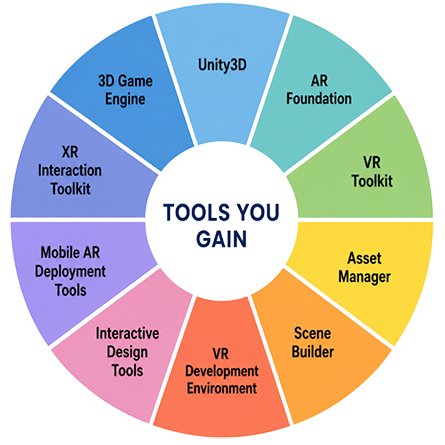
The industry-standard tools used for developing Augmented Reality (AR) and Virtual Reality (VR) applications, providing students with practical exposure to immersive technology development platforms.
Salesforce CRM Core Skills Matrix
| Unity3D | AR Foundation | VR Toolkit |
| Asset Manager | Scene Builder | VR Development Environment |
| Interactive Design Tools | Mobile AR Deployment Tools XR Interaction Toolkit | |
| 3D Game Engine | AR Development Platform |
Career Opportunities
The objective of the IoT & 5G Technologies program is to enable students to understand next-generation communication technologies, design and develop IoT applications, and integrate intelligent devices with advanced 5G networks. The program provides industry-relevant skills in wireless communication embedded systems, IoT architectures, cloud connectivity, edge computing, cybersecurity, and smart applications for Industry 4.0.
The curriculum is designed to provide comprehensive knowledge and practical skills in Internet of Things (IoT), 5G communication technologies, embedded systems, wireless networking, cloud and edge computing, cybersecurity, and smart connected systems. Through hands-on laboratories, real-world projects, and industry-oriented applications, students develop the technical competencies required to design, develop, integrate, and deploy secure, scalable, and intelligent IoT solutions for Industry 4.0 and next-generation digital ecosystems.
Topics Covered
| Introduction to IoT & 5G: | Introduction to IoT, wireless communication evolution from 1G to 5G, Industry 4.0 concepts, IoT ecosystem, IoT architecture, and key features of 5G networks. |
|---|---|
| Wireless Standards & IoT Architectures: | Wireless communication standards, standardization bodies (3GPP, ITU), 5G spectrum, IoT communication models, design methodologies, and reference architectures. |
| Sensors, Actuators & Embedded Systems: | Fundamentals of sensors and actuators, embedded systems for IoT, Arduino programming, ESP32 development, and Raspberry Pi applications. |
| IoT Communication Technologies & Protocols: | Wi-Fi, Bluetooth, ZigBee, LoRaWAN, NB-IoT, MQTT, CoAP, HTTP, and application-layer communication protocols. |
| 5G Architecture & IoT Integration: | 5G core network functions, service-based architecture, integration of IoT with 5G networks, and Massive Machine-Type Communications (mMTC). |
| IoT Applications & Smart Systems: | IoT applications in smart cities, smart manufacturing, connected vehicles, healthcare, agriculture, energy, and transportation sectors |
| Edge Computing & Cloud Analytics: | Edge computing, Mobile Edge Computing (MEC), fog computing, cloud platforms for IoT, data storage, and real-time analytics. |
| Security, Privacy & Emerging Technologies: | Network slicing, private 5G networks, non-terrestrial networks (NTN), authentication, privacy, cybersecurity challenges, AIoT, digital twins, and future 6G technologies. |
| Hands-on Implementation & Projects: | Sensor interfacing, device configuration, data collection, MQTT communication, cloud connectivity, dashboard development, mini-project implementation, and project demonstrations |
Tools you learn: The essential hardware, communication, cloud, analytics, and development tools used to design, develop, connect, monitor, and deploy Internet of Things (IoT) and 5G-enabled smart applications
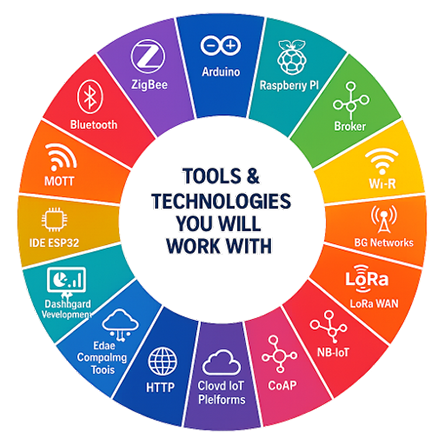
By working with tools such as Arduino, Raspberry Pi, ESP32, MQTT, Wi-Fi, LoRaWAN, NB-IoT, Bluetooth, ZigBee, Cloud IoT Platforms, and Edge Computing Tools, students develop practical skills in device connectivity, real-time data acquisition, cloud integration, analytics, and intelligent IoT application development as below
IoT & 5G Technologies Core Skills Matrix
| Arduino | Raspberry Pi | Broker | Wi-Fi |
| 5G Networks | Lora WAN | NB-IoT CoAP HTTP | Cloud IoT Platforms |
| Edge Computing Tools | Dashboard | Development Data | Analytics Tools |
| IDE ESP32 | MQTT | Bluetooth | ZigBee |
Career Opportunities:









 Work with Us
 Campus Map
 How to Reach Us
 Online Degree Verification
 IARE Mail
 Photo Gallery
 Virtual Tour