
799 Campus Placements - 2026 :
720 Campus Placements - 2025 :
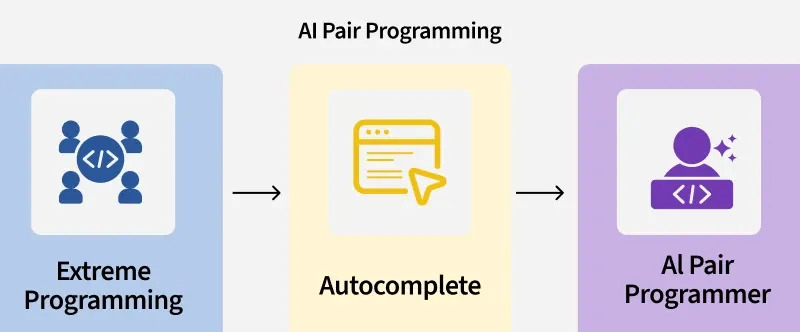
The software industry has recognized the potential impact of code generation tools, making it a significant topic in today’s world. These tools are capable of improving the efficiency of software development, saving time and costs. Pair programming is another widely adopted technique in software engineering, popular for its ability to create high-quality software within a short time frame.
Pair Programming is a software engineering process that involves two programmers collaborating at the same workstation while using this agile software development technique. This process is a component of the extreme programming methodology, which is gaining popularity in businesses. The central concept of pair programming is that two individuals working together on the same problem can derive process improvements that result in better software.
In pair programming, one person assumes the role of the observer or navigator, who carefully observes the driver’s (the second partner) work and offers advice while the other person, the driver, actively types on a computer or documents an architecture or design. The two programmers routinely switch between these two duties.
While reviewing, the observer also takes into account the direction of the work, generating suggestions for enhancements and potential issues to handle in the future. The driver can then focus only on completing the current task, using the observer as a safety net and guide.
It is found that the largest perceived benefits of pair programming were overall fewer bugs in the code, spreading code understanding among the team, and producing higher quality code. However, there may be situations, such as illness, scheduling conflicts, or efficiency concerns, that require the two individuals to work independently. Experienced pair programmers prioritize the stages of the development cycle, deciding which ones are most crucial to work on together and which ones can be completed separately. When they reunite, they must determine how to incorporate the individually created work. As a bigger group starts using pair programming as the standard method of working, the long-term continuity of a specific pair becomes less important. An individual programmer can maintain sufficient general awareness to fill in for an absent partner at a moment’s notice by partnering regularly with every member of the group.
Language models is a type of deep learning model that provides probability distributions of a collection of terms in a language. While earlier language models were based on non-neural techniques, there has been a trend toward using neural networks in recent years. These models are commonly used in natural language processing to generate text. Recurrent neural networks (RNNs) have been the primary building block of language models in this shift. They take input sequences and produce a corresponding output probability distribution for the subsequent tokens in a sequence. The traditional LSTM architectures outperform more modern models when properly regularized, which was a rather unexpected result.
RNN-based language models are useful for a wide range of tasks, such as part-of-speech labeling, question-answering, and machine translation. While RNNs generally offer better performance than other models, they also suffer from a short-term memory problem, which can impact their performance, particularly when dealing with lengthy input sequences.
The field of software development has now advanced to the point where machine learning tools and techniques can be employed in the coding process using deep learning and natural language processing. As a result, developers can now make extensive use of code completion and generation technologies offered by integrated development environments (IDEs) or as add-ons to text editors.
As NLP/DL technology develops, these code completion tools get more complex. An advanced code completion tool is Copilot from GitHub. An "AI pair programmer trained on billions of lines of public code," according to Copilot’s description. Copilot, a text editor add-on for the VSCode text editor, creates potential code completions for developers by taking into account the program’s context.
Code generation tools using machine learning, belongs to one of three groups.
The majority of code generation studies fall in the first category with 46 %, the second category had 25 % selected studies.
Codex is a GPT language model fine-tuned on publicly available code from GitHub, specifically developed to produce code. It is claimed to produce best results for Python code-writing capabilities. A distinct production version of Codex powers GitHub Copilot. It may generate code fragments that are typically both syntactically and semantically sound when given a brief user description.
OpenAI developed Codex using a unique approach, based on their discovery the repeatedly sampling from the model can be an effective tactic for generating useful answers to challenging problems. By using this approach and sampling multiple times per problem, they were able to solve more problems. This method can increase the chances of finding a suitable solution. By utilizing Codex’s ability to generate code, developers can benefit from this approach and increase their chances of finding efficient and effective solutions to their coding challenges.
Copilot is an AI-powered tool created by Microsoft that functions as an "AI pair programmer." It is capable of generating code in multiple programming languages based on the contex provided as a prompt, including nearby code, comments, and method names.
Copilot offers three primary functionalities:
The tool is using in its core Codex that have been specifically trained and fine-tuned for the purpose of generating code.
GitHub suggests that not all the code used was tested for bugs, insecure practices, or personal data, despite the glowing reviews of Copilot’s productivity improvements on the website. The company writes they have put a few filters in place to prevent Copilot from generating offensive language, but it might not be perfect. The company also cautions that although this is uncommon and that the data has been discovered to be synthetic or pseudo-randomly generated by the algorithm, the model could suggest email addresses, API keys, or phone numbers. However, the majority of the Copilot-generated code is original. Only a small fraction of the generated code could be replicated exactly in the training set.
The foundation of Copilot is OpenAI’s Codex, this is a refined version of GPT-3. This package can be used within visual studio code with different settings and was promoted as being a tool that the programmer can pair with.
DeepMind Alpha Code is an innovative AI system developed by Google-owned DeepMind. The system relies on a powerful combination of deep learning and reinforcement learning techniques to achieve its model. It’s powered by a neural network with millions of parameters that have been fine-tuned through training on simulated games. By using deep learning, AlphaCode is able to analyze and understand complex patterns in data, allowing it to make accurate predictions and decisions. And by using reinforcement learning, it is able to learn from its mistakes and continually improve its performance over time.
The potential applications of AlphaCode are wide-ranging and include different fields from robotics and self-driving cars to medical diagnosis and scientific research.
Amazon CodeWhisperer is a new AI-powered tool developed by Amazon Web Services (AWS) that aims to assist developers in the software development process. The tool utilizes natural language processing (NLP) and machine learning techniques to provide suggestions and auto-complete code segments based on the developer’s programming language. The system is designed to learn from developers’ usage patterns and improve its recommendations over time. According to AWS, CodeWhisperer has shown promising results in reducing the time and effort required to develop high-quality code.
CodeWhisperer can extract patterns and structures from the code to make suggestions to developers, including auto-completion of code segments, highlighting code errors, and providing recommendations for code improvement. The system’s machine learning algorithms also enables it to learn from developers’ usage patterns, making it more effective over time.
One of the features of CodeWhisperer is its ability to suggest code for a developer based on their intent. The system uses natural language processing (NLP) techniques to analyze the developer’s code and provide suggestions that are aligned with their intended goals. This feature can improve the productivity of developers by reducing the time required to write code manually. CodeWhisperer can be integrated with other AWS services, such as Amazon SageMaker, to provide a complete AI-assisted development experience.
The core tools would be:
n8n is a workflow automation and orchestration platform that allows users to connect applications, APIs, databases, and AI models through visual workflows with little or no coding.
n8n does not contain its own LLM. Instead, it can integrate with:
User Query → n8n Workflow → GPT/Llama → Database → Email/Slack Response
The n8n can be classified under Workflow Automation & Agentic AI Platforms
No-Code/Low-Code AI Development Tools









 Work with Us
 Campus Map
 How to Reach Us
 Online Degree Verification
 IARE Mail
 Photo Gallery
 Virtual Tour